Showing posts with label cool. Show all posts
Showing posts with label cool. Show all posts
Thursday, February 14, 2013


Friday, July 13, 2012


Friday, May 11, 2012
Skate Spot Etiquette
Wow, haven't posted in quite awhile, been running around like, well, a busy person, but here is something I thought deserves way more face time, enjoy.
Certainly needs to be shared! Until next time...
Skate Spot Etiquette by Cann0n on silverfishlongboarding.com
"Why have a Spot Etiquette?
Preserving the sanctity of a wonderful skate spot should be a natural feeling to any seasoned skater. Newcomers may do something careless, like get or cause injuries, damage property, litter, hit cars, and etc., which can cause a spot to serve consequences to attendees of a future session.
What does it mean when a Spot gets Blown Out?
When a Spot gets Blown Out, local officials and residence don't enjoy our company. The tolerance toward skaters by the local community is subject to rejection upon visible or audible disturbance. In other words, someone will have a problem with skaters skating that spot, ask you to leave or simply call the local police station. Refusing to leave is a sure way to end a friendly situation.
How do I prevent spots from getting blown out?
Keep spots to yourself. The more people that know about it, the faster it will be blown out. Don't mention road names or have them visible in videos. Spot etiquette should be followed regardless of whatever location you skate. Remember to smile and wave at all passersby. Be friendly and courteous of the community you skate in. Pick up all your trash, be conscious of your language (don't curse, especially around children) and be mindful of others using the road. Wear your safety gear, accidents happen. Calling 911 is the last thing you want. Always wearing your helmet can help prevent a bad situation. Cars should be avoided at all costs! If a car is coming the other way, stay in your lane or get off the road altogether.
Who Blew Out the Spot?
The skater(s) that attract unwanted attention. Large groups or gathers of skaters, which is why it's not the best idea to idle around at the bottom and waste time talking. Skaters that skate outside of their ability and crash. Skaters that fail to be aware of their surroundings, skating right out in front of cars or police. Cars own the streets, not skaters. Skateboards are easily crushed by cars. Severe injury, which may consists of an emergency rescue, can persuade local law the installment of a rule/sign that is intended to reduce future injury or other liability issues. Sharing skate spots with the masses (internet) allow a spot to be subject to overuse. The more skaters, greater the chance of causing an issue with the locals. In every case, the skater(s) are not aware that they are blowing out the spot(s).
Did I Step On Anyone Toes?
It is very likely that someone was offended that you skated their spot. Some spots are held so sacred by the native skaters, an outside-skater must understand the power of such a bond with ideal terrain. If you have seen the spot in a video, it is likely not yours to skate unless you are invited. This is not always true for many skate spots are not filmed. There is no way of a outsider knowing. It is best to contact people you know that do skate these spots to escort you on that particular skate sesh. Don't bring friends to gnarly skate spots, especially if the terrain is far above their skill level.
Where Do I Skate?
Every skater has his or her favorite spot. Find a spot. Drive around until you find one in your neck of the woods. Get with your friends and localize your spots. There are spots hidden in the most desolate areas. Always assume you aren't the only one skating that spot.
What Are Spotters?
Spotters are people that stay at the bottom intersection or blind corner that keep a lookout for traffic, pedestrians, or other hazards. Signs should be used in order to signal skaters on their journey down in case they need to stop exists. It is very dangerous skating through an intersection blindly. Spotters are your remote eyes. If people are sitting around watching, tell one of them to save your life and keep an eye out.

Who Uses Hand Gestures and Sign Language?
There are many gestures someone can use. Both spotter and fellow skaters are advised to use signals. This will allow a skater so signal the skaters directly in rear. It is wise to be courtesy to the individuals traveling behind you.


This guy isn't the best spotter; he should be in the middle of the road making sure you see him. Make sure your spotter is focused on saving YOUR life.
What If I Don't Know How To Slide?
A good rule of thumb is "do not skate faster than you can stop". Stopping is important. If you are going faster than you can skate, you are skating outside of your limit. You are a danger yourself and to those skating downhill with you. If so, you should probably learn to Coleman slide. RipTide How To: Coleman Slide (180 and Pendy) - YouTube
Lessons Learned.
1. Know your limits.
2. Wear proper gear.
3. Progress in a controlled environment.
4. Respect the roads and respect the residents. Always be courteous and friendly. We are not entitled to anything, At best, we are uninvited guests. It is YOUR job to ensure that we have hills to skate for years to come.
5. Don't blow out spots.
Check out this awesome thread!
Downhill Etiquette by Kevin Reimer
Share this with your friends. Spread spot preservation awareness.
Credits to Sheldon Jacobson for the ideas and Mike Watts for being him. Jared Tyler too."
Preserving the sanctity of a wonderful skate spot should be a natural feeling to any seasoned skater. Newcomers may do something careless, like get or cause injuries, damage property, litter, hit cars, and etc., which can cause a spot to serve consequences to attendees of a future session.
What does it mean when a Spot gets Blown Out?
When a Spot gets Blown Out, local officials and residence don't enjoy our company. The tolerance toward skaters by the local community is subject to rejection upon visible or audible disturbance. In other words, someone will have a problem with skaters skating that spot, ask you to leave or simply call the local police station. Refusing to leave is a sure way to end a friendly situation.
How do I prevent spots from getting blown out?
Keep spots to yourself. The more people that know about it, the faster it will be blown out. Don't mention road names or have them visible in videos. Spot etiquette should be followed regardless of whatever location you skate. Remember to smile and wave at all passersby. Be friendly and courteous of the community you skate in. Pick up all your trash, be conscious of your language (don't curse, especially around children) and be mindful of others using the road. Wear your safety gear, accidents happen. Calling 911 is the last thing you want. Always wearing your helmet can help prevent a bad situation. Cars should be avoided at all costs! If a car is coming the other way, stay in your lane or get off the road altogether.
Who Blew Out the Spot?
The skater(s) that attract unwanted attention. Large groups or gathers of skaters, which is why it's not the best idea to idle around at the bottom and waste time talking. Skaters that skate outside of their ability and crash. Skaters that fail to be aware of their surroundings, skating right out in front of cars or police. Cars own the streets, not skaters. Skateboards are easily crushed by cars. Severe injury, which may consists of an emergency rescue, can persuade local law the installment of a rule/sign that is intended to reduce future injury or other liability issues. Sharing skate spots with the masses (internet) allow a spot to be subject to overuse. The more skaters, greater the chance of causing an issue with the locals. In every case, the skater(s) are not aware that they are blowing out the spot(s).
Did I Step On Anyone Toes?
It is very likely that someone was offended that you skated their spot. Some spots are held so sacred by the native skaters, an outside-skater must understand the power of such a bond with ideal terrain. If you have seen the spot in a video, it is likely not yours to skate unless you are invited. This is not always true for many skate spots are not filmed. There is no way of a outsider knowing. It is best to contact people you know that do skate these spots to escort you on that particular skate sesh. Don't bring friends to gnarly skate spots, especially if the terrain is far above their skill level.
Where Do I Skate?
Every skater has his or her favorite spot. Find a spot. Drive around until you find one in your neck of the woods. Get with your friends and localize your spots. There are spots hidden in the most desolate areas. Always assume you aren't the only one skating that spot.
What Are Spotters?
Spotters are people that stay at the bottom intersection or blind corner that keep a lookout for traffic, pedestrians, or other hazards. Signs should be used in order to signal skaters on their journey down in case they need to stop exists. It is very dangerous skating through an intersection blindly. Spotters are your remote eyes. If people are sitting around watching, tell one of them to save your life and keep an eye out.
Who Uses Hand Gestures and Sign Language?
There are many gestures someone can use. Both spotter and fellow skaters are advised to use signals. This will allow a skater so signal the skaters directly in rear. It is wise to be courtesy to the individuals traveling behind you.
This guy isn't the best spotter; he should be in the middle of the road making sure you see him. Make sure your spotter is focused on saving YOUR life.
What If I Don't Know How To Slide?
A good rule of thumb is "do not skate faster than you can stop". Stopping is important. If you are going faster than you can skate, you are skating outside of your limit. You are a danger yourself and to those skating downhill with you. If so, you should probably learn to Coleman slide. RipTide How To: Coleman Slide (180 and Pendy) - YouTube
Lessons Learned.
1. Know your limits.
2. Wear proper gear.
3. Progress in a controlled environment.
4. Respect the roads and respect the residents. Always be courteous and friendly. We are not entitled to anything, At best, we are uninvited guests. It is YOUR job to ensure that we have hills to skate for years to come.
5. Don't blow out spots.
Check out this awesome thread!
Downhill Etiquette by Kevin Reimer
Share this with your friends. Spread spot preservation awareness.
Credits to Sheldon Jacobson for the ideas and Mike Watts for being him. Jared Tyler too."
Thursday, December 08, 2011
Vegan On A Budget: Mashed Potatoes and Soup!
Okay just quick post. This one is simple and really cheap; about $1.25 per serving depending on where you get your soup.
The Recipe?
1 Box Instant Mashed Potatoes
1 Can Soup (I use a no-name chunky vegetable soup)
Instructions
1) Follow instructions for 2 (for me its usually 4 actually) servings of mashed potatoes.
2) Cook soup according to instructions on can.
3) Combine in induviual bowls.
Done!
Really simple, super quick, and filling! Enjoy!
Tuesday, December 06, 2011
Vegan On A Budget: Baked Potato Soup Bowl
In these tough economic times it can be rather hard to be vegan on a budget, but have no fear it is possible to be ethical and economical! Here is a simple yet filling little recipe I wiped up the other day for lunch.

 The Recipe (serves two)
2 Medium or Large Potato's (depending on how hungry you are)
1 Can of your favorite soup (I used Amy's Lentil)
1 Tablespoon of Parsley for garnish
1) Preheat oven to 350°, wash potato's and stab with a fork on one side, place in oven for 30 to 40 minutes.
2) When the potato's are almost done cook soup according to instructions on can, set aside.
3) Take potato's out and cut off one side, then dig out the flesh with a fork and set aside.
Extra step: Instead of setting potato flesh aside make a little pile in the center of a plate and place potato on top
4)Spoon soup into potato and top with garnish.
Enjoy! More coming soon.


2 Medium or Large Potato's (depending on how hungry you are)
1 Can of your favorite soup (I used Amy's Lentil)
1 Tablespoon of Parsley for garnish
1) Preheat oven to 350°, wash potato's and stab with a fork on one side, place in oven for 30 to 40 minutes.
2) When the potato's are almost done cook soup according to instructions on can, set aside.
3) Take potato's out and cut off one side, then dig out the flesh with a fork and set aside.
Extra step: Instead of setting potato flesh aside make a little pile in the center of a plate and place potato on top
4)Spoon soup into potato and top with garnish.
Enjoy! More coming soon.
Thursday, October 06, 2011
Five Ways to Spruce Up PB&J

Written by Ashley Palmer.
"School is back in session, and let's be honest: By now, you've probably resorted to packing peanut butter and jelly sandwiches every day. Don't get me wrong—I love peanut butter and jelly sandwiches. They're the perfect vegetarian food! But packed lunches can become pretty dull. To help you out, here are five easy ways to spruce up the classic PB&J sandwich:
- Add freshly sliced bananas to your favorite sandwich for an extra layer of flavor and a strong dose of fiber and potassium. Other good options include diced strawberries and halved grapes.
- Switch up the jelly. If you're used to using grape jelly, switch to strawberry or raspberry. Or even try your hand at making your own homemade blueberry jam!
- Try using almond butter in place of peanut butter. Not only is it delicious, it also doesn't usually contain any added oils or sugar, which are frequently found in peanut butter.
- Bake your own fresh, homemade bread. Nothing quite compares to the freshness of a well-made loaf of bread. Try your hand at one of the many easy (and accidentally vegan) bread recipes found online.
- Bust out the cookie cutters. Make your child's lunch more interesting by cutting up his or her sandwich into fun shapes like hearts, stars, and dinosaurs.
If you're feeling really bold, why not try all five tips at one time? What are your tricks for keeping variety in your lunches and those of your kids? Share with us in the comments section below."
Other suggestions:
Other suggestions:
- Mix it up. Use more then one kind of jelly.
- Add other kinds of fruit, like raisins or dried cranberries.
- Use other exotic butters like sunbutter (sunflower seed butter) packed full of zinc and other vitamins. Or even make your own!
No matter what your preference there are tons of ways to have a quick and simple but very nutritious PB&J all at once!
Tuesday, July 12, 2011
Freebord Represent Tour: ColoRADo!

When: July 30th – 31st, 2011
Where:
Meet at Sage Dr. at the base of Lookout Mountain on Saturday, July 30th at 12:00pm. Directions
What to bring:
Helmet/Pads, Tools, Freebord, Camera Equipment, and Preesh
Details:
Hosted by one of our favorite shredders, Mike D, this event will last the whole weekend and include some of the best hills Colorado has to offer. This one is sure to be epic and pro riders will be there!
Info:
Come join the CO Freebord Crew for an epic day of shredding Colorado’s beautiful mountain roads! A full day of riding, filming, chillin, shenanigans and what ever else we can find. Everyone is welcome from beginners to pro-steez riding. We have a ton of spots to ride that will suit almost any rider. Last year’s Rep tour ride was insane, and we’re hoping to outdo ourselves again!
Contact: Mike DePhillips (412) 720-8453
Wednesday, July 06, 2011
longboard related. GAME - BITE THE BAG
Great game, fun, good practice for boarding and well just awesome. Check it out!
Check you later!
Friday, May 27, 2011
Movment Longboarding from Orange County NY
I hear these guys have been doing some great things! I have to give them props on both their riding and a great video! So check out their site at MovementLongboarding.com and check them on Twitter!
Monday, May 09, 2011
Buffalo Bill's Downhill Bloodspill 2011


The finals were canceled and we are left with a tie between Zak Maytum and Kevin Reimer for 1st, and a tie between Alex Toungue and Kyle Martin for 2nd
Saturday, May 07, 2011
A Newbies Guide to Choosing Your Setup.
Brought to you with limited bias.
Choosing your setup is very important. Depending on what discipline(s) you choose (what you plan to do on the board,) from Speedboarding, Sliding, Dancing, Carving, or just cruising around, you need a board thats right for you. Some may ask, 'But I'm new, how would I know what I need?" I'm here to tell you. First we need to consider what the intended purpose for the board is, and what it needs to be good at (personal design preference comes later.)

Speedboarding:
The thrill of pushing the limits of speed have held mankind since they learned to run -they shortly thereafter learned how to crash.
Stability- You need to be able to stay on the board. Stability means a long wheelbase, wide trucks, and usually restrictive or stiff bushings.
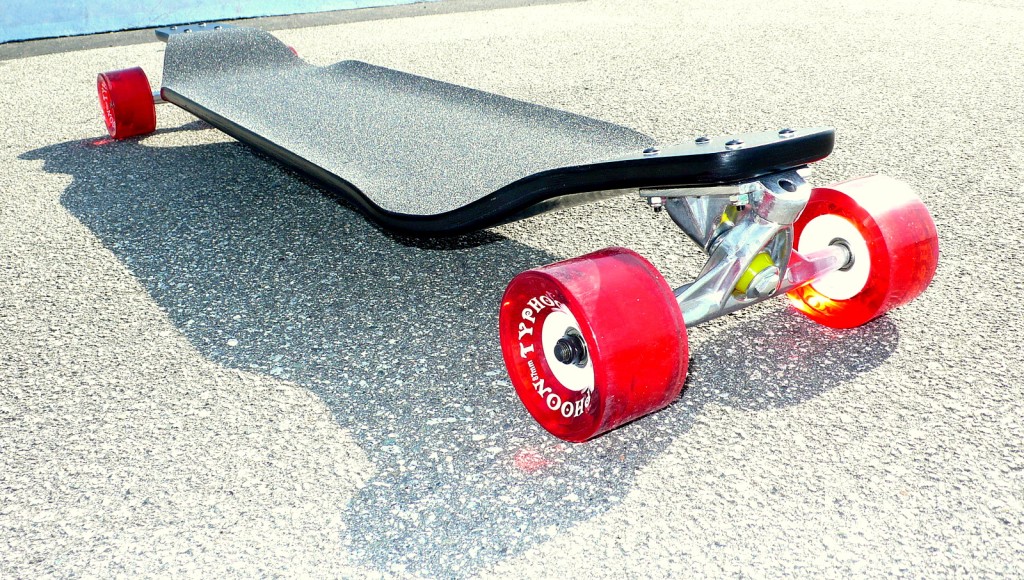
Grip through corners- While staying on the board is important you eventually need to turn, this means a wide board, this will let you put your weight right on top of the wheels pushing them into the pavement and providing grip; also skinny trucks, the skinnier the trucks the more of that pressure you put on the edge of your board gets transfered to the wheels also giving you grip, but beware this sacrifices stability so try to find a good middle that compensates for your skills. Also if you are going to fast to take a turn you need to pre-drift, so you don`t want more grip then will let you slide a little.


Sliding:
Going sideways is fun and some times very important for downhill riders, but for a board that is built to do nothing else you need some specialization.
NO GRIP! If you want to go in a direction the cavemen never intended wheels to go, grip is your enemy. You want wheels with well rounded on the edges and very hard, the softer the urethane the more the wheel conforms to the road, we don't want that. Another thing that helps the lack of grip is wide trucks, the wider your trucks the more leverage over the bushings you have and the less of that pressure gets transfered to the wheels.
Dancing:
From the Jitter Bug to Brake dancing, you've gotta get groovy! While that may be quite hard for us white boys, it is still a ton of fun.
It's gotta be long- No not that you dirty person, your board. If your going to dance you need space, most people like boards around 36" - 42" long.


Bushing return to center. When dancing it is a very good idea to have bushings with a good return to center (bushings like Venom SHR's are an excellent example.) they makes your board go strait unless you want to turn, and with lots of fancy foot work this is a very good idea.
Carving:
Longboarding was created to imitate surfing. To really feel like surfing on pavement you need the right setup.
Turn-ability- When surfing you have little to no resistance when turning, so the less force trying to push your board to center the better, depending on your weight you want the softest bushings you can handle.
Grip- Like speedboarding good grip is a good idea when carving.

 |
| Holey Trucks |
Cruising:
This one is easy. Whatever feels good under your feet no need for skills or advanced tech, it's all about personal preference!
Personal Design Preference:
After what the board is for, personal preference varies greatly. There are so many different skateboard designs, fishtails, to pintails, symmetrical, to directional boards. Your board should be an extension of you, design something that fits your personality. Don't settle. Chances are you can get a custom board for not much more.

So, no matter what you like to do on a longboard ride hard, ride safe, and have fun.
Monday, February 14, 2011
LYFE Kitchen, a vegatairain & vegan friendly food chain.
Founder Stephen Sidwell and CEO Mike Roberts -formerly McDonalds Executives- have teamed up with Oprah’s celebrity chefs in a healthy fast food restaurant chain concept and recently announced plans to launch LYFE ("Love Your Food Everyday") Kitchen, a transformational, socially responsible "lyfestyle" brand that will open in Palo Alto, Calif., this summer.
Roberts, who previously oversaw more than 31,000 McDonald's restaurants in 118 countries, resigned as president and chief operating officer of the fast-food empire in 2006. He was approached by Sidwell, an investment banker, and the two agreed that the time was ripe for a healthy fast-food option.
Chicago-based Lyfe plans to open its first restaurant in northern California late this year, anticipating as many as 250 restaurants nationally over the next five years.
Of course, if the food doesn't taste good, nobody will buy it — no matter how well it's branded. To complete that part of the puzzle, Roberts and Sidwell turned to Chef Art Smith, former personal chef to Oprah Winfreyand a two-time James Beard Foundation Award winner. They also recruited vegan chef Tal Ronnen, author of The Conscious Cook; both celebrity chefs to Oprah Winfrey contributed to the development of the menu. Not all vegan, the menu will include Niman ranch grass fed beef burgers alongside Gardein veggie burger options. All the desserts will be dairy free.
Though skeptics say healthy fast food on this scale is too much of a niche market, the Lyfe team is confident that tides are turning in their favor. San Francisco recently banned McDonald’s Happy Meals, Disney World turned over a former McDonald’s location to a vegan and gluten-free bakery and with campaigns such as Mrs. Obama’s Chef Moves initiative bringing healthier school lunches to students, consumer demand for healthier options has never been higher.
While having some former McDonald's executives on board (their chief communications officer is also a former 20-year veteran of the company), isn't without some irony, it makes perfect business sense. Why not build a new healthy fast-food empire using the lessons and experienced garnered from the previous?
"With two celebrated, taste-making chefs and a talented team of leaders and advisers, we believe LYFE Kitchen is a response to one of America's most significant, unmet needs: the consumer's demand for delicious, affordable food that is good for you," said Roberts. "We also plan to become a part of the Palo Altocommunity and begin giving back right away."
"Every decision we make — from using eco-friendly building and packaging materials, to ingredients we source, to providing an engaged service team and partnering with local nonprofits — will engage and inspire our guests, and ultimately, have a tremendous impact," explained Sidwell.
We'll find out just how successful the new menu is this summer. Till then, vegan and vegetarians hoping for some quick food options while on the road can remain optimistic.
Sunday, February 06, 2011
Wiggler on Wheels
Written by Jeff Vyain
Wednesday, 02 February 2011
Bustin's Jeff Vyain has been riffing on boarding, bushing and now wheels on the very cool "Bustin Blog". Check out his fresh view of...
All You Need to Know About Longboard Wheels

"It’s been a while since I wrote one of these. Part of the reason I waited so long was because I was intimidated to tackle products such as wheels, trucks, and boards without making a ton of assumptions. So much innovation is still happening in longboarding because everyone still has different ideas about what works and what’s just a load of hype, and we’re all constantly trying out new ideas and coming to new conclusions. I’m going to do my best in the following post to give as objective of an opinion as I can about wheels, but understand that we’re still learning–that the entire industry is still learning. Still, I’ve got this wall o’ wheels right in front of me and have access to riding tons of different boards and setups from people all over the city, and I’m a super-dork when it comes to longboard components and have done a lot of research, so I feel like I have a pretty good handle on a lot of this. I trust my own opinion. You can decide for yourself what you think!
Like the previous Bustin Blog post on bushings, I’m going to talk about wheels in terms of their characteristics. I don’t want to get too specific talking about individual wheels; rather, I’d like to give you the tools to be able to look at a wheel, identify its characteristics, and make a fairly strong judgement on how it should handle before you make a purchase. The characteristics I am choosing are lip shape, durometer, size, core size, core position, contact patch width, contact finish, and urethane formula.
Lip Shape – When I speak of lip shape, I am referring to the shape of the edge of the wheel. This is going to be one of four shapes (until someone makes up something new). The shape of the lip mostly affects how easily the wheel will let go and slide sideways, so I’m going to list them in order from the stickiest wheel to the most slidey wheel.


Core Size – The size of the core will greatly affect how a wheel responds on the road, it’s ratio of grip to slip, it’s acceleration and ability to hold speed, and the comfort of the wheel on the road for the rider. Some common larger cored wheels are Abec 11 Flywheels, Seismic Speed Vents, and Landyachtz Zombie Hawgs. Wheels like Seismic Hot Spots have medium sized cores. Most wheels have smaller cores. This is probably mostly due to the fact the cores have already been made by the wheel manufacturer, and it costs much more money for a wheel company to make a proprietary core, but smaller cored wheels also have their advantages.
Smaller cored wheels generally:

Larger cored wheels generally:

A centerset core will have an equal amount of urethane on either side of the core. These wheels tend to be quite sticky, as a large portion of the grip that a wheel has is generated by the wheel is focused on the inside lip, and centerset wheels usually have a relatively large inner lip. Grippins and Centrax wheels from Abec11 are perfect examples of this.
Some centerset wheels are also made for sliding. They tend to have smaller contact patches than the centerset wheels that are made to grip, but because they are centerset, you can flip the wheel and expect to have the same performance. This adds to the life of the wheel, because as it begins to cone (the inside of the wheel wears away quicker than the outside, thereby creating a subtle cone-shape), you can flip the wheel and even out the wear pattern and continue skating on it. The Venom Street Snake and Sidewinder are great examples of this, as are a host of wheels by Abec11, such as the Invertz, Noschoolz, and Skertz. Flywheels act as a nice in-between wheel here. They are large centerset wheels that slide fairly easily and predictably with their rounded edges and large core, but they also have a fairly wide contact patch to grip when you need them to, and because they are flippable, they tend to last for quite a while.
The only real notable negative aspect of centerset wheels is that they tend to bite a little easier, because the larger inner lip brings the wheel closer to dropthrough decks. On topmount decks, it’s usually the outside of the wheel that catches the board, so it does not apply in this case.
Sideset wheels have cores that are positioned on the inner lip of the wheel. These wheels tend to slide more progressively and predictably than center or offset wheels. These tend to be great freeride wheels, but unfortunately, they cone quite a bit faster and as a result, don’t last as long. The Landyachtz Zombie Hawgs are a great example of a sideset freeride wheel, as they have round edges with a stone-ground finish and large cores, resulting in a very predictable slide in every way possible. Abec11 Flashbacks are another very popular sideset wheel.
Offset wheels have cores that are positioned somewhere between the center and the inside lip of the wheel. The majority of wheels made these days are offset. Abec11 Zigzags, Bigzigs, Bustin Bocas, every current wheel from Orangatang, Siesmic Speed Vents, Hot Spots, and Blast Waves, 3DM Avilas and Avalons, Fireball Incendo and Beasts–all offset wheels, as well as a slew of others. Offset wheels tend to be quite grippy and, depending on other factors, may slide quite progressively as well. Most downhill and slalom wheels these days are offset as well as many freeride oriented wheels, which have very similar shapes but usually have round edges and may have a stone-ground finish.
Contact Patch Width – Wider contact patches have more grip. Thinner contact patches have less grip. All other things being equal. Bam.

Contact Patch Finish – Most wheels simply come out of the wheel mold smooth and shiny, get a little shaving on the sides to clean up the wheel and voila! they’re done. The shiny finish on a brand new wheel tends to be very sticky, and this is while you’ll see most pro downhill riders breaking out brand new wheels for each downhill event (and sometimes each run down the hill!) Over the past year+, we’ve seen some other wheels come to the market with stone-ground finishes. This adds a step in the manufacturing process and makes the wheels slightly more expensive, but it essentially makes the wheel slide much easier right out of the box and takes away from the break-in period where slide are a little less predictable (and less safe) as you’re wearing away the shiny finish of the wheel. To date, the only wheels I know of that have stone-ground finishes are the Stimulus and Durian from Orangatang, the Incendo and Beast from Fireball, the Sidewinders by Venom, the Metro Motions, and the Zombie Hawgs from Landyachtz. Look for more wheels coming out in 2011 with stone-ground finishes. They have been very well received by skaters over the past year as “freeriding” has become more and more prevalent.
Urethane Formula – All polyurethane is not the same. Getting the formula just right is often a very difficult, time consuming, and expensive task, and you can usually tell a pretty substantial difference between cheap urethane and the better quality stuff. Rebound is the most substantial quality that is affected by urethane quality. Rebound can be defined as the tendency of urethane, once compressed, to expand to return back to it’s initial state, and it can fairly easily measured by simply dropping a wheel from shoulder height and comparing how well it bounces back up from wheel to wheel. Rebound is important because as a wheel compresses when it is rolling over objects, it will first compress around them, and then it will press against the object and actually help drive the wheel forward as it tries to return back to its round shape. A wheel with little rebound will simply blast into rocks or bumps and jump over them with little compression and less powerful/lively expansion. This slows the wheel down.
Most wheels that we see these days from respectable wheel companies like Abec11, Seismic, Bustin, Earthwing, Venom, Atobe, Orangatang, Landyachtz, and 3DM, are made in one of two major wheel manufacturing plants and have very similar urethane with high rebound. Some of the more mass produced wheels out there have Chinese urethane, and I would advise against these if you can afford the better stuff, because it will most definitely impact the quality of your ride.
That’s all for this edition of the “All you need to know about Longboard Wheels” blog. There is probably TOO much information in here, yet I know I had to have missed some things worth talking about, so if you have any suggestions about topics to expand upon or disagree with anything I said here, please feel free to comment and we’ll talk about it! By learning the concepts of what makes a wheel act like it does, you should now be able to take a wheel in your hand and make pretty accurate assumptions about how it is going to respond based on its characteristics. Now’s a good time to take a mental breather and go for a skate! Scram!"
For more of Jeff's writings, visit The Bustin Blog
Wednesday, 02 February 2011
Bustin's Jeff Vyain has been riffing on boarding, bushing and now wheels on the very cool "Bustin Blog". Check out his fresh view of...
All You Need to Know About Longboard Wheels

"It’s been a while since I wrote one of these. Part of the reason I waited so long was because I was intimidated to tackle products such as wheels, trucks, and boards without making a ton of assumptions. So much innovation is still happening in longboarding because everyone still has different ideas about what works and what’s just a load of hype, and we’re all constantly trying out new ideas and coming to new conclusions. I’m going to do my best in the following post to give as objective of an opinion as I can about wheels, but understand that we’re still learning–that the entire industry is still learning. Still, I’ve got this wall o’ wheels right in front of me and have access to riding tons of different boards and setups from people all over the city, and I’m a super-dork when it comes to longboard components and have done a lot of research, so I feel like I have a pretty good handle on a lot of this. I trust my own opinion. You can decide for yourself what you think!
Like the previous Bustin Blog post on bushings, I’m going to talk about wheels in terms of their characteristics. I don’t want to get too specific talking about individual wheels; rather, I’d like to give you the tools to be able to look at a wheel, identify its characteristics, and make a fairly strong judgement on how it should handle before you make a purchase. The characteristics I am choosing are lip shape, durometer, size, core size, core position, contact patch width, contact finish, and urethane formula.
Lip Shape – When I speak of lip shape, I am referring to the shape of the edge of the wheel. This is going to be one of four shapes (until someone makes up something new). The shape of the lip mostly affects how easily the wheel will let go and slide sideways, so I’m going to list them in order from the stickiest wheel to the most slidey wheel.

- Acute Angled Lip – The lip on these wheels is flat across the bottom of the wheel, comes to a sharp point at the edge, and heads back toward the center at an acute angle on the side of the wheel. The only wheels I can think of off the top of my head that are currently in production using an acute angled lip are the 75mm Avila and its younger sibling, the 70mm Avalon, both made by 3DM. These wheels shine on the slalom course, from tight slalom all the way to super giant slalom. They stick turns as hard or harder than just about any wheel ever made. The thin edge of the wheel molds to the road surface more than any other type of wheel, providing the most possible traction. These wheels are not made to slide; the lip will likely chunk off in places if forced to do so. The Atobe Bonneville is also somewhat shaped this way, but the edge is a little less sharp and a little more round, which seems to keep the wheel from chunking during slides without giving up much, if any, traction.
- Square Lip – The square lipped wheel is among the most common type of wheels in production. The bottom of the wheel goes straight across, forms a 90 degree angle at the lip and goes straight up before heading back into the core. Some of the most common square lipped wheels include the Orangatang 4President and InHeat, the Abec11 Zigzag, BigZig, and Centrax, Seismic Hot Spot and Speed Vent, and Venom Cannibals. The square lip provides exceptional traction. When the wheel is carving through a turn, force is transferred toward the edge of the wheel, which flattens out slightly and forms a platform and sticks the turn. The advantage of a square lipped wheel over the acute angled lip is mainly longevity and the ability to break the wheel in so that it slides easily. With an acute angled lip wheel, if you try to slide it, it will likely just chunk off and mostly ruin the wheel; however, with the square lip, though there is usually a bit of a break-in period, the wheel can be essentially turned into a nice sticky wheel that’s capable of drifting with just a little bit of work. This is the type of wheel that 98% of downhill racers will be riding on any given day and for good reason. It’s a tough and reliable shape that you can count on to stick when you want it to and slip when you want it to.

- Beveled Lip – The beveled lipped wheel is shaped like a square lipped wheel, except that on one or both edges, the wheel forms a sharp 135 degree angle (half of the 90 degree turn) and then another angle to round off the 90 degrees before heading back into the core of the wheel. A great example of this is the Bustin Boca wheel, which has bevels on both sides. I haven’t found a lot of good information about beveled lips, but I’ll give you my best logical input on what the point is behind these wheels. First, the outer bevel basically forms a little bit softer of an angle when rolling over cracks, small curbs, and stones at an angle. This essentially just helps you keep from getting stuck on objects and helps keep the ride smooth. I have literally taken a shallow angle up against a NYC curb and rolled up the curb on some yellow Boca wheels. I was totally expecting to get stopped in my tracks, and when I made it, I had to go back and look at the curb again to see what happened. The curb was taller than the wheel! So how did this happen? Well, my best guess is that the soft angle formed by the bevel actually allowed the wheel to crab against the face of the curb (rather than run straight into it) and lift the board over. This certainly isn’t something you will do every day, but it is a prime example of an advantage that a beveled outer lip offers. Additionally, this is essentially a softer edge to have to wear down once you’re ready to start sliding your wheels. Theinner bevel is a little harder to get a grasp on. My opinion is that an inner bevel tends to make the wheel a little bit grippier, in that because of the additional mass outside of the contact patch, when you are driving angular force down through a wheel in a turn, there is less of a tendency for the wheel to flex and change shape against the road. This could potentially add to wheels life and help keep the wheel from coning. I’d like to hear other opinions on this matter, as there doesn’t seem to be much discussion going on about it, yet companies are still creating wheels with beveled inner lips! My theory is that if two wheels made of the same urethane with the same size contact patch go head to head, the one with the beveled inner lip will be stickier and have greater rolling momentum.
- Rounded Lip – Rounded lipped curve from the contact patch up to the side. Also referred to as radiused wheels, they have the most progressive transfer from grip to slip and tend to be the most predictable when sliding. Some great slide wheels out there include the Stimulus and Durian from Orangatang, the Sidewinder from Venom, Earthwing Slide-A, Abec 11 Freeride, and loads of other wheels. Rounded lips are a somewhat classic shape and can be found all over. Like the beveled lipped wheel, rounded lips will typically roll over objects and up curbs better than a sharp-lipped wheel. They are also better for bowl and ramp riding, as they will roll over and off the coping more easily and create less hangups.
Durometer – Durometer refers to the softness of the urethane. Most wheels made for longboarding are going to have the classification of “A.” So when you see a wheel that says 78a or 90a, you will know what the “a” means. It could be a B, C, or D, but urethane this hard would typically be considered too hard for longboarding. The lower the number, the softer the wheel. I do not know of any longboard wheels that are softer than 72a. The higher number, then, the harder the wheel. Not many wheels out there are being ridden that are over 100a. I’m not sure what the Slide-A’s are, but they’re probably close to that hard.
Softer wheels will typically be more grippy. This isn’t always the case, as there are many other factors that play into grip and slip, but as a general rule, this holds true. Softer wheels also tend to ride softer, providing more cushion, and rolling over road inconsistencies more smoothly. Harder wheels, then, slide easier and are generally considered faster over super smooth surfaces. The big question is the middle ground. How soft for every day riding? How hard for a fairly smooth downhill run? This is such a subjective topic, so it’s one that I’m somewhat hesitant to chime in on, but I’ll do so anyway.
For most flat ground riding on typical (rough in some spots, smooth in some spots) surfaces, I think somewhere between 78a and 82a is ideal. Too soft, and your wheel may not have enough rebound to really be fast. Too hard, and you’ll collide into inconsistencies in the road rather roll right over them. Rebound is not the exact same thing as durometer, but they are closely related. A higher rebound urethane will be faster, as it will deform and then reform on the backside of these inconsistencies (rocks, pebbles) in the road and actually push against and away from the backside of them. This makes the wheel faster. If the wheel is too hard to ever deform, though, it is simply running into objects in your path and slowing you down.
This applies to essentially all types of riding. Rougher surfaces (like most city roads) require softer wheels to go faster, while hard and smooth surfaces (like concrete skate parks) will benefit from harder wheels that deform less.
Size – The size or diameter of the wheel primarily affects 4 things – acceleration, momentum, ability to roll over stuff, and ride height.
- Acceleration – Smaller wheels accelerate faster, whereas larger wheels accelerate slower. This is true on most levels and has mostly to do with weight. So it is possible that a smaller diameter wheel with a super wide contact patch may accelerate slower than a larger diameter wheel with a super thin contact patch.
- Momentum – Larger wheels have greater mass, and objects with greater mass carry greater momentum. This does not apply only to the diameter of the wheel but should also apply to wheels with wider contact patches/widths, as they will be greater in mass than those with less width. What this means is that while a larger wheel may be tougher to accelerate to speed, a larger wheel will hold speed while coasting longer than a smaller wheel. This is especially useful in some downhill courses when the hill starts off steep and then flattens out at some point. You will be able to hold a tuck for a longer period of time before resorting to pushing, or you may carry more speed going into the next steep section.
- Ability to roll over stuff – Children’s toes, potholes, stones, trash, and small curbs stand much less of a match for large diameter wheels than those with a small diameter. However large the object is, assuming it is smaller than half the size of the wheel, if a large wheel rolls over this object, it will, to a lesser extent, smash straight into the object and instead roll over it (if you’re lucky).
- Ride height – A larger diameter wheel will ride higher than a smaller wheel, all other things being equal. The difference is often very little, but a quarter of an inch will be a noticeable difference for most people. This makes a difference in how the board sticks to the road vs. slides, and it also makes a difference to the pusher, though it is totally up for debate how ride height affects performance.
Core Size – The size of the core will greatly affect how a wheel responds on the road, it’s ratio of grip to slip, it’s acceleration and ability to hold speed, and the comfort of the wheel on the road for the rider. Some common larger cored wheels are Abec 11 Flywheels, Seismic Speed Vents, and Landyachtz Zombie Hawgs. Wheels like Seismic Hot Spots have medium sized cores. Most wheels have smaller cores. This is probably mostly due to the fact the cores have already been made by the wheel manufacturer, and it costs much more money for a wheel company to make a proprietary core, but smaller cored wheels also have their advantages.
Smaller cored wheels generally:
- accelerate faster, due to decreased mass.
- slide smoother and lose traction earlier, due to a thinner patch of urethane between the core and the road. The ‘thane flexes less and generally will scrub across the road rather than chatter.
- decelerate faster, due to less mass and, in turn, inertia.
Larger cored wheels generally:
- accelerate slower, due to increased mass (all other things being equal).
- hold speed longer, due to increased mass/intertia
- feel smoother over rough pavement. More ‘thane means the wheel can flex more over bumps, cracks, stones, toes, etc.
- have more grip, because there is more urethane flexing and grabbing at the road.
Core Position – Skateboard/longboard wheel cores are usually positioned in one of three ways. Cores are either centerset, sideset, or offset.
A centerset core will have an equal amount of urethane on either side of the core. These wheels tend to be quite sticky, as a large portion of the grip that a wheel has is generated by the wheel is focused on the inside lip, and centerset wheels usually have a relatively large inner lip. Grippins and Centrax wheels from Abec11 are perfect examples of this.
Some centerset wheels are also made for sliding. They tend to have smaller contact patches than the centerset wheels that are made to grip, but because they are centerset, you can flip the wheel and expect to have the same performance. This adds to the life of the wheel, because as it begins to cone (the inside of the wheel wears away quicker than the outside, thereby creating a subtle cone-shape), you can flip the wheel and even out the wear pattern and continue skating on it. The Venom Street Snake and Sidewinder are great examples of this, as are a host of wheels by Abec11, such as the Invertz, Noschoolz, and Skertz. Flywheels act as a nice in-between wheel here. They are large centerset wheels that slide fairly easily and predictably with their rounded edges and large core, but they also have a fairly wide contact patch to grip when you need them to, and because they are flippable, they tend to last for quite a while.
The only real notable negative aspect of centerset wheels is that they tend to bite a little easier, because the larger inner lip brings the wheel closer to dropthrough decks. On topmount decks, it’s usually the outside of the wheel that catches the board, so it does not apply in this case.
Sideset wheels have cores that are positioned on the inner lip of the wheel. These wheels tend to slide more progressively and predictably than center or offset wheels. These tend to be great freeride wheels, but unfortunately, they cone quite a bit faster and as a result, don’t last as long. The Landyachtz Zombie Hawgs are a great example of a sideset freeride wheel, as they have round edges with a stone-ground finish and large cores, resulting in a very predictable slide in every way possible. Abec11 Flashbacks are another very popular sideset wheel.
Offset wheels have cores that are positioned somewhere between the center and the inside lip of the wheel. The majority of wheels made these days are offset. Abec11 Zigzags, Bigzigs, Bustin Bocas, every current wheel from Orangatang, Siesmic Speed Vents, Hot Spots, and Blast Waves, 3DM Avilas and Avalons, Fireball Incendo and Beasts–all offset wheels, as well as a slew of others. Offset wheels tend to be quite grippy and, depending on other factors, may slide quite progressively as well. Most downhill and slalom wheels these days are offset as well as many freeride oriented wheels, which have very similar shapes but usually have round edges and may have a stone-ground finish.
Contact Patch Width – Wider contact patches have more grip. Thinner contact patches have less grip. All other things being equal. Bam.
Contact Patch Finish – Most wheels simply come out of the wheel mold smooth and shiny, get a little shaving on the sides to clean up the wheel and voila! they’re done. The shiny finish on a brand new wheel tends to be very sticky, and this is while you’ll see most pro downhill riders breaking out brand new wheels for each downhill event (and sometimes each run down the hill!) Over the past year+, we’ve seen some other wheels come to the market with stone-ground finishes. This adds a step in the manufacturing process and makes the wheels slightly more expensive, but it essentially makes the wheel slide much easier right out of the box and takes away from the break-in period where slide are a little less predictable (and less safe) as you’re wearing away the shiny finish of the wheel. To date, the only wheels I know of that have stone-ground finishes are the Stimulus and Durian from Orangatang, the Incendo and Beast from Fireball, the Sidewinders by Venom, the Metro Motions, and the Zombie Hawgs from Landyachtz. Look for more wheels coming out in 2011 with stone-ground finishes. They have been very well received by skaters over the past year as “freeriding” has become more and more prevalent.
Urethane Formula – All polyurethane is not the same. Getting the formula just right is often a very difficult, time consuming, and expensive task, and you can usually tell a pretty substantial difference between cheap urethane and the better quality stuff. Rebound is the most substantial quality that is affected by urethane quality. Rebound can be defined as the tendency of urethane, once compressed, to expand to return back to it’s initial state, and it can fairly easily measured by simply dropping a wheel from shoulder height and comparing how well it bounces back up from wheel to wheel. Rebound is important because as a wheel compresses when it is rolling over objects, it will first compress around them, and then it will press against the object and actually help drive the wheel forward as it tries to return back to its round shape. A wheel with little rebound will simply blast into rocks or bumps and jump over them with little compression and less powerful/lively expansion. This slows the wheel down.
Most wheels that we see these days from respectable wheel companies like Abec11, Seismic, Bustin, Earthwing, Venom, Atobe, Orangatang, Landyachtz, and 3DM, are made in one of two major wheel manufacturing plants and have very similar urethane with high rebound. Some of the more mass produced wheels out there have Chinese urethane, and I would advise against these if you can afford the better stuff, because it will most definitely impact the quality of your ride.
That’s all for this edition of the “All you need to know about Longboard Wheels” blog. There is probably TOO much information in here, yet I know I had to have missed some things worth talking about, so if you have any suggestions about topics to expand upon or disagree with anything I said here, please feel free to comment and we’ll talk about it! By learning the concepts of what makes a wheel act like it does, you should now be able to take a wheel in your hand and make pretty accurate assumptions about how it is going to respond based on its characteristics. Now’s a good time to take a mental breather and go for a skate! Scram!"
For more of Jeff's writings, visit The Bustin Blog
Subscribe to:
Posts (Atom)